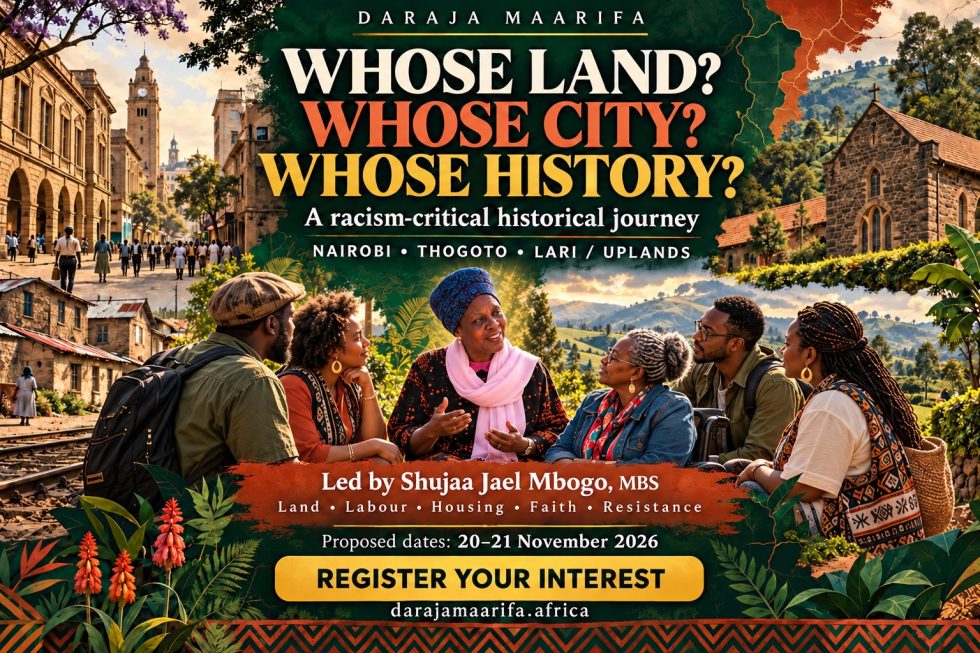
Whose Land? Whose City? Whose History?
Explore Nairobi and Lari/Uplands with Shujaa Jael Mbogo, MBS
Explore Nairobi and Lari/Uplands with Shujaa Jael Mbogo, MBS
Who could own land? Who needed permission to move? Who built Nairobi, and who was allowed to call it home?
Join Daraja Maarifa for a proposed two-day journey through Kenya’s colonial history, led by Shujaa Jael Mbogo, MBS.
From Nairobi’s city centre and workers’ neighbourhoods to the mission landscape of Thogoto and the historic grounds of Lari/Uplands, we will explore how colonial power shaped everyday life: through housing, employment, schooling, religion, land, and belonging.
Along the way, we will examine how people navigated restrictions, challenged authority, organised their communities, and created possibilities for themselves and future generations.
Proposed dates: Friday 20 and Saturday 21 November 2026
Registration of interest is now open
Your tour leader: Shujaa Jael Mbogo, MBS
Learn alongside a leader who helped shape the histories we encounter
Shujaa Jael Mbogo brings a deep personal connection to Nairobi’s past. As a nominated councillor representing Eastlands communities during the colonial period, she regularly intervened on behalf of African residents arrested or harassed by the authorities. She later served as national chairperson of Maendeleo ya Wanawake and as Deputy General Secretary of the All Africa Conference of Churches.
Her pioneering work for women’s civic participation and leadership is also the subject of contemporary historical scholarship. Drawing on her writings and oral testimony, researchers have highlighted her role in challenging accounts of Kenya’s public life that relegate women’s contributions to the margins.
Honours recognising her contributions
Her decades of public service have earned distinguished national honours and recognition, including:
- Moran of the Order of the Burning Spear (MBS), 2018 – a Kenyan national honour.
- Mashujaa Day Recognition (2021) – honouring her lifelong contributions to freedom, democracy, gender justice, and human development.
With Shujaa Jael Mbogo leading this journey, participants are invited to listen, ask questions, and connect historic sites with the firsthand experiences and reflections she shares.
Day One: Who was allowed to call Nairobi home?
Movement, labour, housing, and the making of a city
Our first day explores Nairobi by examining the relationship between colonial authority and everyday life.
Identification and control: the city centre
Our proposed opening stop is outside Kipande House, where we introduce the history of identity passes, employment records, and the systematic restriction of African movement.
The kipande system linked personal identity directly with wage labour and the regulation of movement. It offers a vital starting point for understanding how racial control operated through administrative paperwork and routine bureaucracy.
Our questions: Who was forced to account for their presence? Who moved freely? What happened when a person’s right to live and work in the city depended entirely on official permission?
Infrastructure and empire: railway heritage
A proposed visit to the Nairobi Railway Museum brings archival maps, photographs, and preserved railway artefacts into our discussion, drawing on the Kenya Railways collections.
We will use this railway heritage to examine the connections between infrastructure, labour, and imperial power, contrasting the distinct experiences of African and South Asian workers.
Our questions: Whose labour made the railway possible? Who benefited from the connections it created? What do we miss when imperial infrastructure is described simply as “progress”?
Homes and belonging: Jogoo Road and Eastlands
From the city centre, the proposed route continues towards Jogoo Road, Makongeni, and neighbouring Kaloleni.
Historical research connects Makongeni with railway workers’ housing and distinguishes it from Kaloleni’s municipal housing schemes. Together, these neighbourhoods illustrate how housing, labour, and racial separation were institutionalised.
We will explore workers’ everyday lives alongside family relationships, women’s experiences, and the mutual support systems residents built.
Our questions: Was an African worker treated as a resident with rights, or principally as a unit of labour? What space was available for family life? How did people make homes within systems designed to restrict them?
Note: Because Makongeni has experienced recent demolitions, our visit will depend on an on-the-ground assessment of what remains and respectful coordination with current and former residents.
Bringing the city’s stories together
We close the day with a seated conversation connecting themes of mobility, wages, housing, and belonging.
Participants will have dedicated space to reflect on what these histories reveal about racism as a structural system of rules and institutions, alongside the organised actions residents took to challenge exclusion and build community.
Day Two: Who could own the land, and tell its history?
Missions, knowledge, land, and remembrance
Our second day takes us beyond Nairobi’s urban neighbourhoods towards Thogoto and Lari/Uplands.
Thogoto: knowledge, belief, and authority
A proposed visit to the Thogoto mission area (subject to site permission) opens a conversation about Christianity, formal schooling, language, and colonial authority. Institutional archives and scholarly accounts document Thogoto’s mission station, schools, farms, and medical facilities.
We will examine African responses, including adoption, adaptation, and active resistance, while recognising that rich traditions of African knowledge and education flourished well beyond mission institutions.
Our questions: Who decided which knowledge counted? What opportunities did mission education offer, and what cultural expectations accompanied it? How did African communities negotiate faith, tradition, and authority?
Reading the landscape: land and livelihoods
As we travel towards Lari/Uplands, we will examine colonial land alienation, displacement, and changing rural livelihoods through historical maps and locally verified accounts.
Our aim is to connect the physical landscape with enduring questions of ownership, dispossession, and power.
Our questions: Who claimed customary rights to land, and whose ownership was recognised by colonial law? How did changes in land access disrupt families and alter relationships within communities?
Note: Any roadside stopping points for this discussion will be selected following a route and safety inspection.
Lari/Uplands: violence, resistance, and contested memory
Lari is a central destination of this programme.
Here, we will explore the complex conditions preceding the violence of 26 March 1953, the Mau Mau attack, the civilian casualties, the subsequent state reprisals, and the wider colonial Emergency.
Historical research examines the local land and political disputes preceding the massacre. Community heritage initiatives also document the deep wounds left by the violence and ongoing efforts to foster healing and remembrance.
We will also examine how these events were narrated at the time: investigating how colonial propaganda highlighted insurgent atrocities while obscuring or sanitising official repression.
Our questions: Whose deaths were publicised, and whose suffering received little attention? How do we honour civilian victims while critically examining the structural violence and circumstances surrounding the conflict?
Note: Exact visiting locations and protocols in Lari will be established in partnership with local community knowledge holders. We approach Lari with deep respect for the people and families connected to these histories.
Closing reflection: what do we carry away?
We conclude with time for collective reflection:
How has this journey shifted the way we understand the city, the landscape, and the histories we inherited?
What responsibilities come with hearing these accounts? What will we question differently when we encounter familiar descriptions of colonial Kenya?
What makes this journey racism-critical?
Our approach directly examines how racial hierarchy functioned through institutions, legal classifications, and unequal access to land, labour, housing, and knowledge.
We ask whose perspectives shaped dominant historical records, whose contributions were sidelined, and what emerges when African experiences and agency guide our inquiry.
Throughout the journey, we carefully distinguish between documented historical evidence, analytical interpretation, and lived personal recollection. Participants are warmly invited to ask questions and engage thoughtfully with historical complexity.
This programme is strictly educational and historical; it does not endorse or promote any political party or candidate.
Who is this journey for?
We welcome Nairobi residents, visitors, diaspora travellers, educators, students, and anyone seeking a deeper, more grounded understanding of Kenya’s past.
No specialist historical background is required, just curiosity, a willingness to listen, and an openness to questioning familiar narratives.
Kiswahili for Every Level
Beginner Kiswahili
What we carry. What we question. What we become.
Kiswahili for Every Level
Beginner Kiswahili

Learn knowledge
And skills in a variety of ways

Quality lectures
To data visualisations

Online Tutorials
With quizzes, open exams